100 Scuba Dives…Dive Mom Needs Help!

Dive Mom Ready to Go
Dive Mom Ready to Go!

“For the first time I can remember, I don’t have my 100 dives by November 1; I need your help to get there before December 1!”

 Ann Keibler will be venturing up to the DUI Dog Rally and Demo Days in Terrell Texas on November 19-20 and she would like for you to join her. So that you both have something to do while swimming around the lake, she will be doing dry suit open water dives and dry suit demos. To give you some incentive to show up, she has come up with the following specials:

  • Take a Dry Suit course, reg $225, for only $125 and she will pay for your DUI entry ticket for Saturday and Sunday. By doing your open water here, you also save the dry suit rental charge ($100 for the weekend).
  • Take your Nitrox course, reg $225, for only $125 and she will pay for your DUI entry ticket for the day and include the Nitrox for your dives!

Both courses include the educational materials and the classroom portion is a home study program. You should turn in your homework and take the test before you leave. She will be staying late Wednesday November 9, so you can get the test over with early. You can take the test at the lake, but who wants to skip the fun and take a test so doing it early is really better.

Of course if you are already certified as a dry suit diver, you can still come up and go diving. Remember, she needs a lot of dives and she doesn’t think any one person will want to do that many in a day. As such, she needs multiple buddies and lots of moral support.

DUI’s Dog Rally and Demo Days is a really cool event where you can try almost every suit DUI makes, almost every style of undergarment, get lunch and a hat all for $10.00 (when purchased from Oceanic Ventures, in advance). And, if you are already a DOG (DUI Owners Group) and you bring a friend to the event, you will get a special gift.

Please send Dive Mom and email and tell her you will help her reach her goal.

She would like to know who is going to attend by Friday.

Technical Training at Local Destinations or Not?

Divers walking to waterRecently I was asked why I don’t do more technical training in the deep lakes in Texas.  My reasoning has to do with both philosophy and the environment. 

First, let’s look at the environment itself.  The lakes have the advantage of being close allowing for short drives from home. To some, this helps keep the training costs lower, especially if you can camp near the lake.  They are familiar dive sites to many of the divers in the area so there is an increased comfort level which is beneficial for the student.  The problem with the lakes is that they are generally not very clear because of sediment and algae.  Because of the reduced visibility, class sizes are limited, which is not a bad thing, and students are forced to swim very close to one another or on a line.  While following a line is a good skill to learn, it inhibits the diver’s ability to fully integrate the skills and procedures into their diving.

The deeper lakes also tend to be cold at depth.  To properly train in this environment, the student needs a drysui or at a minimum a thick wetsuit.  This requires that they be comfortable with drysuit diving before the course starts because starting a technical diving program introduces more equipment and skills so adding a suit that the diver is not familiar with diving adds more complications to an already stressful situation.

This is not to say that a student cannot learn in this environment.  There are many skilled and successful divers who started their training in murky local lakes and quarries.  However, it takes more effort to become proficient in less than ideal conditions.

The second reason I prefer other locations is one of philosophy.  Beginning down the road of technical diving requires that the student develop skills, intuition, and procedures to survive and enjoy the dives.  Swimming with multiple cylinders whether manifolded or separate, as in a side mount configuration, or even on a rebreather requires that you retrain your brain to deal with different buoyancy characteristics and with mass.  I find that students master these skills faster, with more confidence, when they can see what they are doing in relation to their instructor and fellow students.  Further, by allowing them to have more room between them, they can develop better swimming and buoyancy skills in a shorter period of time.  Additionally, with clearer visibility, the stress on the instructor is reduced which I believe makes me more effective in the learning environment.

I also believe that students start this type of diving to do something or to go somewhere.  Some take it merely for the training, but moreover the student has a goal in mind when they enroll in a course.  I have yet to find someone who came to me saying they wanted to find out what the mud looked like at the bottom of Lake Travis.  Diving is about experiences and in my mind it should be predominately positive experiences.

This is not to say that these locations do not have their place in technical diving.  Before leaving for a destination, open water, I like to take the students to one of the shallow training lakes.  This allows them to refine their equipment configurations and develop some buoyancy skills in their new equipment.  You don’t need deep water to work on buoyancy; in fact, it is better to work on it in a shallow area because the trim changes are magnified.  Additionally, these locations allow me to teach some of the skills needed for this type of diving and the start helping them create procedures to deal with equipment and to start building more diving intuition.

For the final dives, I find it to be a more positive experience to go where the water is clear and there is depth and support for the type of diving you are learning.  Since we have completed the knowledge or classroom portion of the course and some basic skills dives prior to leaving for the destination, we can concentrate on the diving and planning when we arrive.

One argument against completing the open water divers in a destination rather than a local lake is the cost.  However, once you figure in the cost of fuel, lodging, meals, entry fees, etc.  The differences are not that great.  By electing to complete your training in a destination like Grand Cayman or Cozumel you will have a better experience and will enjoy the dives more.  Additionally, I believe you will learn faster and progress in this style of diving further because you have a solid foundation on which to build.

How to Be Warmer in Your Wetsuit or Dry Suit


Dick Long in a DUI Signature Suit

Today’s post comes to us from Dick Long, founder and CEO of Diving Unlimited International, the world’s leading manufacturer of dry suits.  Dick hated being cold and built his first wetsuit to keep himself warmer while spearfishing off the coast in San Diego.  He then had friends wanting suits so he built them for his friends as well.  Thus, DUI started as a wetsuit company but Dick still hated being cold so he pioneered the dry suit industry in his quest to stay warm underwater.  He has a great deal of diving experience and has always believed that through his doors stepped the greatest divers in the world.  Everyone in one of his suits is a great diver in their eyes and they strive to build the best products for their clientele.

In his article, Dick draws upon his years of diving experience to help divers stay warmer underwater, either in a wetsuit or a dry suit.

Most divers don’t think much about the problems associated with diving in cold water. Either they grin and bear it, or if they complain, other divers give them a hard time and say they aren’t tough enough. The reality is that diving in cold water poses a significant threat to your safety and robs you of diving enjoyment.

Why Be Warm in the Water?

Warm diving is fun; cold diving is miserable. Although being cold is tolerated in many types of diving, cold is a factor in most underwater accidents. This is a big mistake.

Cold is predictable and preventable. We have the knowledge, technology, and equipment to eliminate cold as a problem in the modern diving world. Our goal is to keep the diver’s body at its normal operating temperature. We do that by controlling the rate of heat loss from the diver to the water.

Where Does Your Body’s Heat Come From?

The muscles are the body’s heat engines. They create heat by metabolizing food during exercise. The circulatory system distributes the heat generated by the muscles. If we exercise a lot we produce a lot of heat. If we exercise little, we produce little heat. To keep warm, we must maximize the blood circulation within our body.

Heat is lost primarily by conduction through your skin. In conduction, heat is transferred from your skin to the water by direct physical contact. Your diving suit is used to control the rate of that heat loss.

Large divers tend to produce more heat than smaller divers. Bigger people have less surface-to-mass ratio so they cool slower, and thereby need less thermal protection. Female divers tend to chill faster than males. Divers with low metabolic rates and older divers also tend to chill faster. The colder the water, the more insulation you will need to control the heat loss.

The important thing to remember is that each individual has separate, distinct thermal needs. Two divers of the same size and sex may require different amounts of insulation. This difference may be as much as three times what the other person must wear to be comfortable.

Even the same diver will require different amounts of insulation depending upon his activity in the water. There’s a big difference in the heat production created by strenuous wreck diving and casual underwater photography.

Being warm is not a comfort issue — it is a safety issue. Today we know that running out of heat is just as deadly as running out of air.

Principles of Operations of Wetsuits

Dick Long in a wetsuit

An Early Picture of Dick Long in a Wetsuit (courtesy of Susan Long)

Wetsuits are made to cover your body with foam neoprene. The water enters the suit and the diver gets wet. Your body heats the water that enters the suit. The air bubbles in the rubber insulates the water and keeps it warm just like a thermos keeps your coffee hot. The proper fit of a wetsuit is critical to minimize water circulation within the suit. Water circulation draws heat energy away from the diver’s body.

What Can You Do To Improve the Efficiency of Your Wetsuit?

A hood attached jacket is recommended to help eliminate water flow coming in around the neck. Any wetsuit that is open at the top, despite how the hood is flanged, allows water to enter between the jacket and suit body. That water circulation, no matter how small, will drain heat from the diver’s body.

Any zippers in the suit allow water circulation unless they are totally waterproof. The use of “skin in”, or smooth neoprene inside, rather than a nylon lining, will eliminate the wicking that naturally occurs through nylon linings.

What Can You Do Prior to Your Dive to Reduce Heat Loss?

Before you dive, avoid drinking anything with caffeine in it, or smoking. Both of these actions cause a shut down of the blood vessels in the extremities, reducing blood flow and making you colder sooner.

Alcohol increases your blood flow to your skin. It is a depressant and will ultimately increase your heat loss.

Prior to the dive you want to keep warm. Make sure you have had good quality food and lots of rest prior to the dive. Your body should be properly fueled with fluids.

Avoid heavy meals just prior to diving and have a diet high in carbohydrates. It’s always wise to do some good stretching and warm-up exercises prior to the dive to get the heart moving in anticipation of the exercise rate.

Overheating prior to the dive causes sweating and disrupts your fluid balance. Overheating also diminishes the body’s capability to produce heat during the dive. It hastens the onset of hypothermia (reduced body temperature) once the diver enters the water.

How to Reduce Heat Loss Between Dives and on Subsequent Dives

If your suit is wet on the outside, stay out of the wind to avoid cooling from evaporation. Cover yourself with a large plastic bag with a hole cut for the head and arms. This helps keep the wind from evaporating the water on the outside of your suit during your transit to and from the next dive site.

On your second and third dives preheat your suit in a hot water shower before you put it on to reduce body heat loss. Start the dive by putting warm water inside your suit, eliminating that first cold shock.

During your dive, avoid urinating in your wetsuit. Although it feels good, it will cause your body to open up your blood vessels in the groin region. This brings warm blood up to reheat cold tissues. The area soon cools off and you end up with a greater net heat loss.

The best way to rewarm is to get out of your wetsuit, dry yourself off and put clothes back on. If warm water is available such as from a shower or the cooling system of an engine, it’s acceptable to use it for rewarming.

The Limitations of Wetsuits

Wetsuit technology is a good reliable technology, but it has its limitations. Do not expect it to do what it cannot. Wetsuits can’t keep you warm at depth. Remember, the wet-suit’s ability to keep you warm is more controlled by the water depth than by the water temperature.

What About Dry Suits?

A dry suit is a waterproof shell, the sole purpose of which is to keep the diver dry. It does not keep the diver warm. It is the insulation that is worn under the dry suit that keeps the diver warm. The primary advantage of a dry suit from this perspective is that it allows you to vary your insulation with the needs of the dive.

There are many factors that will affect the selection of insulation to be worn under your dry suit. These include your exercise rate, your body size and type, and the water temperature. The colder the water or the less you exercise, the more insulation you will need.

How insulation is applied is critical to its effectiveness. Your insulation must be equal to the demands of the dive. It’s important to adjust the system to meet your needs and to choose insulators that are highly efficient. Some are much more efficient than others. It is also important that the underwear be loose enough to achieve maximum freedom of movement.

You need to develop an insulation strategy. You want to maintain thermal equilibrium so you are neither too hot nor too cold. These goals can be achieved by layering your insulation. You can use up to three layers of insulation of varying thicknesses. If this is not enough, don’t add a fourth layer but make one of the layers thicker.

Most people don’t need more than four undergarments to choose from to achieve their desired level of insulation for diving. You can probably use some of the garments you already own from other outdoor activities. Your insulation should include the use of a polyester or polypropylene expeditionary underwear or non-absorbing liner. You might also want to own a heavy vest and a primary set of underwear. For very cold water (under 10 degrees C), or for less strenuous activities, you may want an even heavier set of primary underwear. You now have many combinations from which to choose.

In the warmest of waters, the synthetic liners may be all that you need. As your insulation needs increase, use the liner plus the vest. As the water cools down, you may only use your primary underwear. In colder water, use your primary underwear plus the vest. In the coldest waters, you will want to use the liner, your primary underwear, and the vest. Using this strategy, each person will switch their combinations at different temperatures.

The temperatures at which the individual will change combinations will depend on their being “warm blooded” or “cold blooded”, and their anticipated exercise rate. Trial and error is the best way to work out your personal temperature reference points. Keep in mind too that as you change your underwear, you will need to change your weights. The more insulation you wear, the more weights you will need to wear.

What Can You Do to be Warmer in the Water in Your Dry Suit?

The best insurance to being warm in the water is to maintain your dry suit properly. Make sure your suit is in good repair and doesn’t have any punctures or gouges.

Make sure your dry suit zipper is well lubricated and the valves are clean. A clean, well-lubricated zipper won’t leak, nor will clean valves. Make sure the seals are in good condition and not deteriorating. Be sure they are adjusted for the proper size of your wrist and neck. They should be tight enough to keep the water out, but loose enough to allow blood circulation to be high.

Prior to the dive you should know the water temperature and your expected activity so you can choose the proper kind of insulation. It is helpful to record water temperatures, exercise rate, insulation used and the amount of lead required to neutralize buoyancy in your logbook for future reference.

Remember that the insulation combination you choose will be the major determining factor in how much weight you will require. If you want to wear less weight choose efficient insulation material.

Keep your underwear dry prior to the dive, particularly the boots if the decks are wet. Check to see that your seals are adjusted properly and make sure the zipper is totally closed. A zipper left slightly open is the most common cause of leaks in dry suits.

During the dive you can control your thermal insulation in several ways. If you expect a high exercise rate at the beginning of the dive, you can create a squeeze in your suit during descent and never quite equalize it once you reach the bottom. This will reduce the insulation of your dry suit system.

You can also modify the gas you use to equalize pressure in your suit to help control your warmth. There are some divers who use air in their suits only during the descent and working part of the dive. When they come to their decompression obligation, if it’s a long one, they purge their suits of air and fill them with argon.

Argon is a more efficient insulator than air. Divers who use argon in their dry suits carry a special small cylinder for this purpose. This can increase the insulation capacity of your undergarments by as much as 25 percent.

Underwater photographers may choose to use argon in their dry suits throughout their dives. The best procedure is to inflate the suit with argon prior to the dive from a spare bottle. Allow the argon to mix with the air, purge all the gas mixture out of the suit, then refill and vent three times prior to the dive. As long as you don’t break the seal prior to the dive, you will have close to pure argon in your suit, and maximum warmth.

During the dive, fluid control by the diver is highly important. You want to maintain good hydration. Underwater, due to weightlessness, there’s a natural desire to urinate. There are urination elimination systems which are somewhat complex or you can simply use adult diapers for long duration dives. The adult diapers are usually good for two ventings which will cover the requirements of almost any recreational diver.

Keeping your hands warm is very important. You will find that the use of mitts will always be warmer than gloves. Likewise, the use of dry gloves or mitts will be warmer than wetsuit mitts or gloves.

Wrist rings provide a special sealing system between your dry glove and your dry suit. They lock together to form a watertight seal. The use of wrist rings with your dry gloves will be warmer than using the standard cone latex seals found on some dry gloves and mittens.

After Diving With Your Dry Suit

Even in a dry suit, you want to be sure to stay out of the wind after your dive. One way to add insulation after diving is to put additional air in your suit.

It is as important to keep yourself warm after the dive as it is before the dive, because this will affect decompression. You want to restore blood circulation to its maximum potential as soon as possible after you have exited the water. The placement of a dry suit necklace in the neck seal can be used to take the pressure of the neck seal off the neck. This is an inexpensive ring that relieves the pressure on the neck seal.

If you are cold and want to rewarm, drink warm fluids such as soup and hot cocoa. Again, avoid alcohol for all the obvious reasons.

Between dives keep your underwear dry. Dry out the condensation that has occurred in your suit after each dive.

Most good quality underwear can be wrung out if it gets wet and put back on if necessary. Even though it will feel cold when you first put it back on, once the moisture inside the underwear becomes warm it will still trap a great deal of air. Good quality damp underwear will still be reasonably effective.

Get the Most Out of Your Diving!

Whether you dive with a wetsuit or a dry suit, you can increase your diving safety and pleasure by following these simple tips. Given what we know about keeping divers warm, there is no reason why anyone should not dive in complete comfort. If you get cold on your next dive it’s because you want to be, not because you have to be.

To learn more about Diving Unlimited International, DUI, Drysuits, see their website at www.dui-online.com.  This article appears courtesy of Diving Unlimited International.

DUI DOG Rally and Demo Days

David Morris Dry Suit Diving

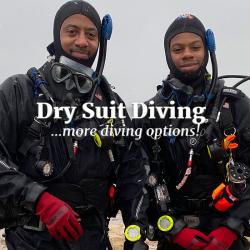
Why would anyone want to put on a dry suit and go diving?  I heard myself say that in my early years of diving and never thought I would ever don one.  Then I met Faith Ortins of Diving Unlimited International and Julie Footman of Aqua Diving Academy in Portland Maine.  Both of these ladies wondered why I would dive in anything else.  Julie went as far to say that she got cold in wetsuits so she always dove in a drysuit, no matter where she went.

Over the years, I have changed my tune.  I found that dry suit diving was not as intimidating as people made it sound and it really extended my diving season.  Diving dry has also opened up new dive locations and made others more comfortable.  I cannot imagine diving in 14mm of rubber again (a 7mm one piece suit with a 7mm xip up vest)!  Ashton learned to dive in a dry suit so he could go ice diving in New Hampshire.  We now run a trip there every year.  We also ran a trip to Antarctica earlier in the year – definitely a dry suit location.

One of the ways to find out more about Dry Suit Diving is to attend the Diving Unlimited International DOG Rally and Demo Days.  DOG stands for DUI Owners Group and there will be divers there from all over the area.  Additionally, you can try out a suit or any type of DUI undergarments.  They bring a truckload of stuff to allow you to try anything in their product line.  Join Oceanic Ventures staff members, Ashton Arsement, and David Morris as they travel to Terrell Texas for the annual Diving Unlimited International, DUI, DOG Rally and Demo Day. 

 For $10.00 (15.00 at the gate) you can try the equipment, have lunch and receive a cap. There is also a dinner Saturday night ($10.00 ticket). Prices are higher at the gate so get your ticket from Oceanic Ventures before the event. You can order them by phone or by emailing Ashton@oceanicventures.com.

Need to know where to go?  Here is more information on Clear Springs Scuba Park [http://www.clearspringsscubapark.com/]

Need more details, drop Ashton a note or call us.

Need to Get Wet & Have Thursday Off? Let’s Go Scuba Diving!

We have had several requests to get wet!  Some of those requests came from bankers who had Thursday off.  So, since the weather is so nice right now, we thought it would be fun to go diving.  We have arranged to go to 288 Lake for some fun in the sun and to practice buoyancy skills.  The plan is to meet at the store at 9:45 and then go down to the lake.  My thoughts were to do a few dives and go somewhere for a late lunch.

If you are interested, please send me an email at divesafe@oceanicventures.com or call me at 713.523.3483, so I can make sure there are enough cylinders.

Let’s go diving!…Eric

DUI Demo Days


Chef Eric

Chef Eric


It is hard to believe it has been a year since we were last here for a rebreather confined water for Mark Conrad, Wade Sparks and Terry DeWolf.  But here we are again for the DUI Demo Days at Lake Travis and this year the water level is up to a reasonable level. 


his year I was joined by a number of our staff including Dive Mom herself, Pat Croll, Vernon Dittrich, Bob Sloan and Wade Sparks.  Vernon and Pat were finishing a class, And I had scheduled this weekend as a practice session and a chance to get some skills out of the way for our Grand Cayman and Inner Space experiences.  Joining me for this session were CCR Normoxic Trimix students Harvey Sisco and Matt Booth.

 Saturday found most of us in the water except for Wade who became the cook for the day, keeping all of the

Chef Wade

Chef Wade

 participants well fed.  Vernon and Pat ran their students through their drills and mine were troopers as well, accomplishing most of the skills leaving only a few for our later dives.

Sunday found me with a plugged up head and students who had accomplished a lot the previous day.  Matt had to teach a class of his own, so Wade and Harvey went diving so Harvey could continue working on his trim.   This left me with Wade’s job from the previous day – that’s right Chef for a day.  Of course, during the night a storm blew in, dumped a lot of rain which continued the next morning.  This made cooking more ao a challenge although it had slowed to a slight drizzle.   The biggest challenge was sinking in the mud in front of the grill or walking around with 20 pounds of Texas Clay caked to my feet.


All-in-all we had a great time and the event was a success.  On top of that, we all had a good time.       


Feeding the CHUM

Chum MeetingDry suits in Texas – what are we crazy? 

When we introduced drysuit diving to Houston (ok, on a retail basis) who would have thought that we would actually have sold some, much less have two regular demo events in the state and make the DUI Hot Sheet for the most dry suit sales in a month? Ann & I certainly planned for the eventuality and Faith Ortins, our friend at DUI had faith in us but to see it happen has been exciting. It is hard to really introduce someone to the concept of Dry Suit diving, especially in Houston which is the gateway to warm Caribbean and Pacific diving but it is fun to help people extend there diving horizons and their diving seasons. 

This evening we had the opportunity to introduce some diving divers to the fun of being warm while underwater.  The City of Houston Underwater Mariners invited us to talk about dry suit diving  and tempt their club members into attending one of the upcoming DUI Demo events, the first of which is in two days and the other in the spring.  DUI helped us by donating a DUI jacket to the event for us to give away and we of course threw in some t-shirts and other give away items. 

This was a special meeting so according to Ryan, there were not as many people as in previous meetings.  Still there were 30 brave souls (lots of rain just before the meeting screwed-up traffic in Houston) who came out to hear me espouse the virtues of drysuit diving.  To entertain them, I obtained a number of slides from friends around the industry showing divers diving dry and some of the places they could dive.  Faith sent me some fun photographs including a photo of divers having martinis on an ice flow in British Columbia (posed of course – you can’t drink and dive!) 

While we were not successful in getting some members of the group interested in joining us that weekend, we did garner some support for the spring event. And, who knows, we may have sent a few of them group thinking there was diving in the winter…