
Care and Feeding of Your Buoyancy Compensator
Ann Keibler Feb 08, 2011
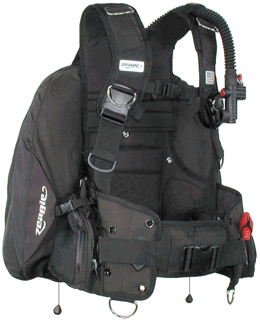
Weight Integrated Buoyancy Device
We also need to give equal attention to our buoyancy compensator device, or BCD, as it is an integral part of our dive system. First and perhaps most obviously, the BCD functions as a place to attach our breathing gas cylinder. It also is where we place our weights and is a great device from which to hang various pieces of dive equipment. Seems to me that the longer I dive, the more things I feel I need to take with me in the water. Let’s see…2 dive lights…safe-second retainer…SPG/computer retainer…dive tool, frequently 2…a slate…a noise-maker…several carabiners…SMB
and a reel…safety sausage…whistle… My BCD just doesn’t seem to have enough pocket space or attachment points lately.
While apparent from its name, perhaps the most important function of the BCD is to give the diver a way to adjust their buoyancy as needed during the dive. From negative buoyancy to stay pinned on the sand, to positive buoyancy on surface at the end of the dive, the BCD gets adjusted numerous times over the course of the dive. Further, we frequently unclip and reclip accessories while diving.
We carry our dive systems around by picking up the BCD with the cylinder and weights in place, tighten and loosen straps, adjust waist bands, clip and unclip, zip and unzip. Basically, that BCD sees more wear and tear than any other piece of equipment in our dive system. So, it only follows that given the expectations of the BCD, and that it is a component in our portable life support systems, it is deserving of care and attention to ensure it works as expected, and lasts as long as we expect. If you look at your dive system, the investment in your BCD is likely equal to that in your air delivery system or your dive computer. The BCD is not a cheap piece of equipment and it is no less important.
Clearly, like the rest of our dive system, the BCD gets wet during a dive, and depending on where you’re diving, post-dive maintenance needs vary somewhat. So, let’s look at what can be done to ensure your BCD functions correctly and lasts a reasonable period of time. To learn more about maintenance and simple repairs, consider taking an Equipment Techniques specialty course.
The BCD carries our breathing gas, so an obvious check would be the cylinder retention straps, their fasteners, buckles and Velcro, plus their attachment points to the body of the BCD. The harness components of the BCD are what holds it to our bodies once we adjust the harness, so those straps and buckles likewise need to be inspected, along with their attachment points to the BCD body. Check the fabric of the straps for fraying and loose threads, and the buckles to ensure they hold the straps in place once adjusted.
Most BCDs have a number of attachment points (D rings typically) and these are where we mount diving accessories. You might have bungee cord, retractable or coil keepers, clips or carabiners which you use to retain accessories. These are things we don’t want to lose when we use them, so having the BCD attachment points in good repair helps to prevent us making continued donations to Neptune. I’m fairly certain he already has enough dive lights, knives and lead. Look at the sewing where the D ring is attached to the BCD body, and if the ring itself is plastic, make sure it’s not cracked or broken.
The visual inspection of the BCD continues to check seams where valves are sewn into the body, all sewn areas, condition of the outer shell fabric- in general, looking for wear and tear or improper function. A general inspection should be done before and after every dive, and a more thorough inspection done before and after a series of dives.
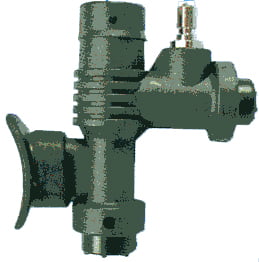
Power Inflator
A good deal of wear and tear on a BCD is due to abrasive particles in the water, and is more a problem when diving in fresh water where the water can be murky from sand and silt. As the BCD flexes from the diver mneung, the particles that are embedded in the fabric will over time damage the fabric. So, following a fresh water dive and preferably before it dries, the BCD needs to be rinsed thoroughly with clean, fresh water to remove the particulate. Aside from the sand and silt, fresh water dives will also likely result in the BCD having residual organic materials left in the fabric. If not cleaned, these can decompose, resulting in mold and mildew and damage to the BCD.
Salt water, while typically containing less sand and silt, does have particulate and – oddly enough- contains lots of salt! If the BCD dries after being in salt water the salt crystals can be even more abrasive damaging than sand and silt from fresh water. So, after salt water diving, and again, before it dries, the BCD needs to be rinsed with clean, fresh water. Sea water also contains organics, and again, mold and mildew can result if the BCD is not thoroughly cleaned.
A session in the pool presents a different issue due to the chlorine present, which can serve to bleach the BCD fabric and over time, weaken the material. Chlorine is highly reactive and public pools are typically heavily chlorinated so after a pool session, just as with lake or salt water diving, the BCD needs to be thoroughly rinsed clean.
I personally have found that using wetsuit shampoo works very well to clean the BCD (and of course your wetsuit and other dive system components) and some formulations even remove salt. There are also treatments that are made specifically to remove salt from dive equipment. After washing, using liquid fabric softener in the rinse water can also help to increase the life of your BCD. The fabric softener remains in the material of the BCD and actually serves to coat strands of fiber, keeping the BCD cleaner, reducing the effects of chlorine bleaching and the deposition of salt crystals. Of course, there’s something to be said for that Mountain Fresh fragrance, too!
Now, we’ve talked about the inspection of your BCD, something you can easily do yourself before and after diving, and that covers the exterior. No less important is the interior of the BCD- the bladder that holds the air, used to keep you neutrally, negatively or positively buoyant, as the situation demands.
The BCD bladder is an integral part of the BCD- it is made from coated fabric which is sewn into the BCD body. While in some cases the bladder can be repaired in the event of a small puncture, if the internal coating is damaged, the BCD will not hold air and cannot be repaired. The only solution is to replace the BCD, and as we noted earlier, your BCD was not an insignificant investment.
During any dive, there is a chance that you’ll get some water in the BCD, usually through the deflator valve or possibly the dump valves. On descending we hold the inflator hose high over our heads and release air from the BCD, and this can result in water entering the BCD bladder. Sometimes, a considerable amount of water enters through the deflator valve, which can present the problem of reducing the BCD bladder volume and can impair the BCD’s ability to prneude lift. A good reason to hone those descent techniques!
Cleaning the inside of the BCD then is vital to its function and longevity. Basically, maintenance of the interior of the BCD amounts to little more than a good rinse after diving, to remove lake water, salt water or pool water and any organics or solids. The BCD bladder is rinsed by putting clean, fresh water into the BCD, swishing well, and then dumping the water out. The fresh water is usually added through the deflator valve, the BCD manually inflated, swish-swish, then inverting the BCD (inflator hose down) and releasing the air/water from the BCD. Repeat! Some BCDs have a nifty adapter that allows a garden hose to be attached, making flushing the BCD simple.
It is strongly recommended that you use a commercial BCD conditioner when you rinse out the bladder. The conditioner treats the polymer interior of the bladder, keeping it from hardening and cracking. It also serves to neutralize any traces of organic materials, salt and chlorine, again extending the life of your BCD. Once the BCD is cleaned inside and out, it should be partially inflated and allowed to dry naturally, out of direct sunlight, and certainly never put in a dryer.
Now, to talk about drying your BCD, and any piece of dive equipment for that matter. While it’s tempting to hang it outside in the sun to hasten its drying and to make it sunshine fresh, UV radiation from sunlight is quite harmful to your equipment and can dramatically shorten its life while it also will bleach color from your BCD, wetsuit, etc . While we are diving, our equipment is certainly exposed to UV (sunlight), often unavoidably. There’s no reason to accelerate any damage by drying the equipment in direct sunlight. Dry it in the shade, with good air circulation.
Just as it is a requirement to have your air delivery system inspected and adjusted at least once a year, having your BCD similarly serviced, by a qualified technician, should be on your calendar, too. Repairs, if needed, can be completed, and your BCD returned to you in “next to new” condition, and you can continue to dive with confidence.
For any equipment related issues, or for your continuing education needs, call or some by OVI soon. We’re here to help!