
Dive Site Geology in the Southern Sea of Cortez
Scott Singleton May 31, 2023
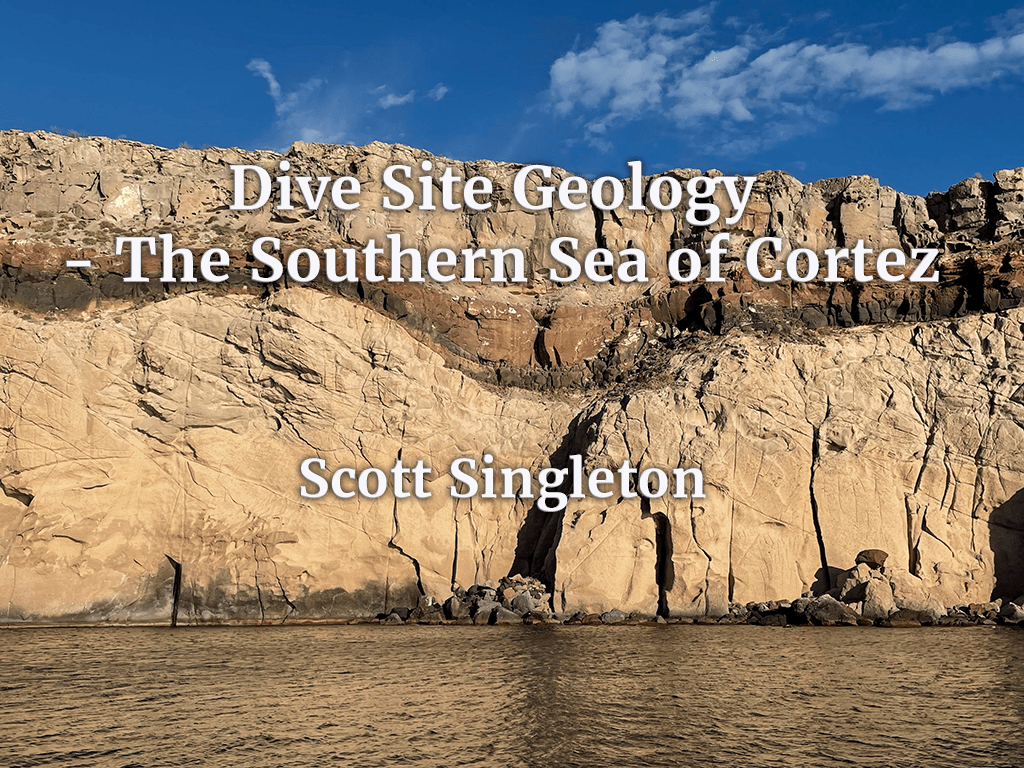
One of the things I enjoy doing is combining my appreciation of the earth with diving. Most of the time the two things are in close juxtaposition as dive sites are often close to shore. And any time a rock exposure presents itself adjacent to the shoreline there is an opportunity to do a bit of geology before jumping into the water for a dive. Most often it’s best to be in a dive skiff which is able to get up close and personal with the rock exposure. That was the case in a recent dive trip I took with Nautilus.
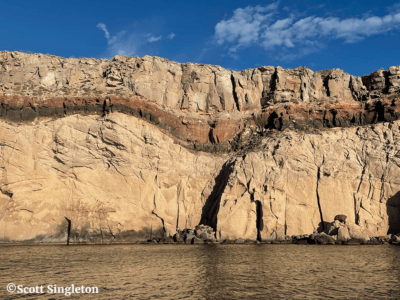
There were also some extrusive (meaning they erupted) ash and lava flows. This was clearly seen on the northern portion of Espirito Santo Island when we visited a sea lion colony called La Reina. Here the lowest unit (that we could see at sea level) was a light-colored ash that was covered (unconformably) by a thinnish dark brown lava flow followed by a reddish-brown lava flow, then a soil zone (seen as a thinnish light red and white layer) which was in turn covered by a massive grayish lava flow.
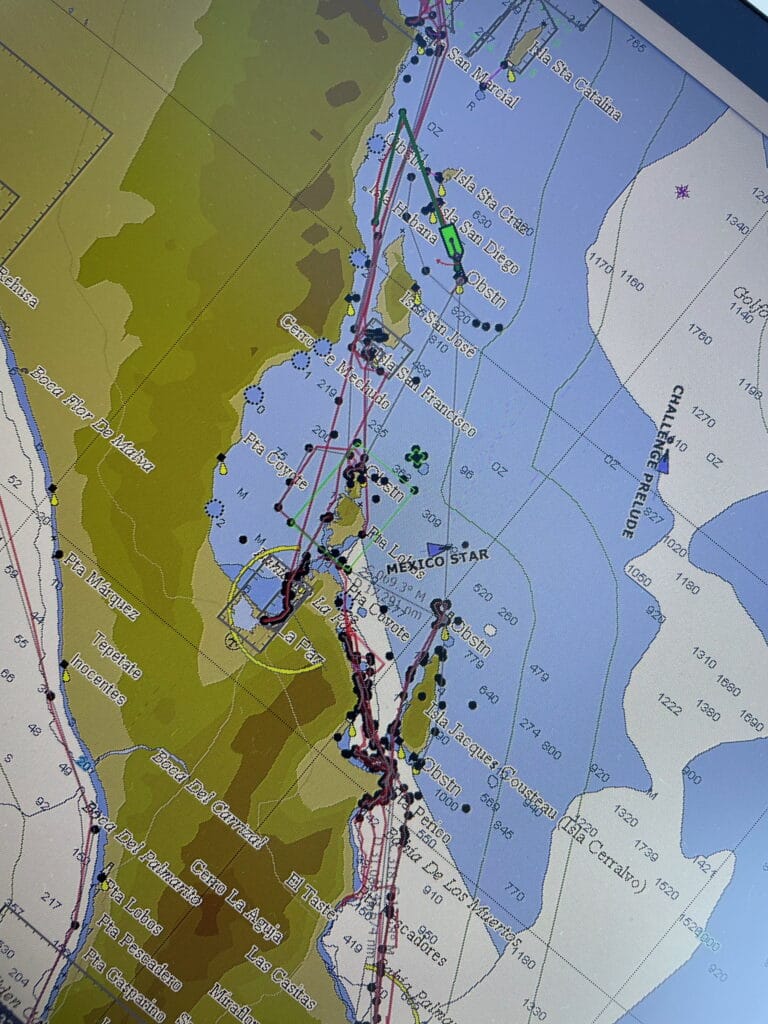
Divers getting readyThe only sedimentary rocks were seen on the mainland coast to the east of La Paz (across from Cerralvo Island) where recent sandstones have been uplifted from the sea due to the tectonic movement of Baja California to the northwest,
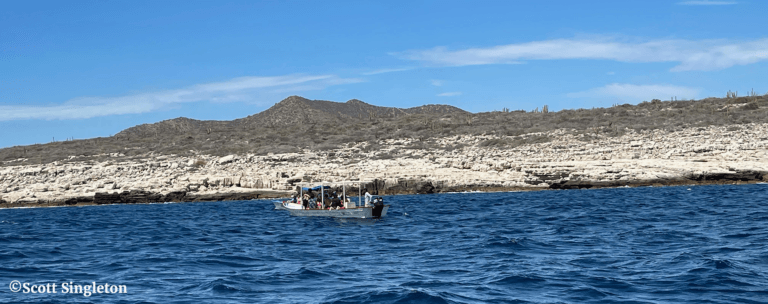
These are just some of the examples of geologic formations found on our recent adventure. But, they are good examples of formations that surround the places we dive. I would encourage you to look beyond the mammals, fish and corals and observe the structures around us when we head out diving. There is a lot more there.
Growing up in the wastelands of New Mexico Scott was surrounded by rocks and dirt but it wasn’t until he read Jules Vern’s Journey to the Center of the Earth that he began to see them as exciting! Knowing that the trip that Jules Vern described was somewhat impossible, Scott pursued Geophysics so he could see what was under the surface without leaving his air-conditioned trailer. Receiving his Bachelor of Science from the New Mexico Institute of Mining and Technology was the first step on his journey which continued through the oil fields of Texas, Oklahoma, and his beloved New Mexico. He later climbed higher receiving his Master’s Degree from Texas A&M University. When he isn’t looking for oil, Scott has become one of the leading experts on wood found in the fossil record in Texas. He recruited his entire family to help on these fossil hunting quests spending hours scrabbling over rocks and brush to find clues to the past. Never ones to sit still, the Singletons (Scott, Eileen and Loraine) discovered the world under the surface of the water, and all became scuba divers traveling to the far reaches of the earth photographing and videoing the underwater and surface scenes they encounter. He combines his love of rocks and fossils with his underwater adventures.