Dry Tortugas Tech Week
Eric Keibler Jun 21, 2009
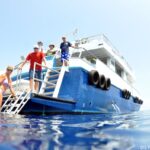
Clear blue water and the gentle hum of the generators breaking the silence of the early morning hours. The wind gently blowing across the deck creates the only other sound. As the sun rises, the water surrounding us shimmers and shines. The sleeping explorers start to stir as the sun rises further from its slumber over the horizon. Soon the boat will be active with divers getting ready to plunge into the crystal clear waters of the Florida straights.
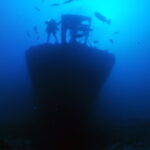
Our Florida wreck diving trip once again finds us over the final resting place of the MS Rhein a causality of the Second World War. The German freighter was sacrificed by her crew in December of 1940 when they set her afire rather than allow her to be captured by the US Navy. This stunning wreck lays in 240 feet of water with her kingposts reaching upwards to 140 feet. Now the home of large schools of fish and goliath groupers, the MS Rhein is seen by few divers.
Today, ten divers (two on open circuit scuba and eight on Closed Circuit Scuba) diving from the M/V Spree had the privilege of visiting this long forgotten piece of history. This is to be the fist of many historical wrecks this group will be visiting. According to Michael Barnette in his book, The Shipwrecks of the Sunshine State:
During 1940 much of the world was focused on the growing hostilities in Europe. However, numerous countries had yet to enter the war, preferring neutrality to a repeat of the bloodshed they encountered in World War I. While the American population opted to ignore and isolate itself from the “European problem,” the Roosevelt Administration recognized that Hitler was a clear and present danger to national security. While neutral at the time, the United States government fully supported Great Britain and her allies. The Declaration of Panama, adopted on October 3, 1939, ordered belligerent nations to stay out of a 300-mile neutrality zone off the coasts of the United States and Latin America. However, this declaration was unilaterally enforced and never applied to those countries fighting the Axis powers. Neutrality Patrols were established in order to assist with the war effort against Germany, while the United States remained “officially” neutral.
The MS Rhein was a 439-foot long freighter, built in Hamburg, Germany, by the Hamburg-America Line in 1926. The latter half of 1940 found the freighter in the neutral port of Tampico, Mexico, separated from the safety of German waters by the expanse of the Gulf of Mexico and the Atlantic Ocean, both filled with prowling Allied warships. November 29, 1940, also found a U.S. Neutrality Patrol consisting of the destroyers USS Simpson (DD-221), USS Broome (DD-210), and USS McCormick (DD-223) on station off Tampico. At 8:35 a.m., the Rhein and Idarwald, another German merchant ship, were observed leaving port and steaming south, staying within Mexican territorial waters. The USS Broome pulled anchor and slowly shadowed the German freighters. On December 7, 1940, the USS McCormick was ordered to relieve the Broome and keep the Rhein under surveillance as she steamed east towards the Florida Straits and the open Atlantic. As the Rhein steadily approached Florida, the USS MacLeish (DD-220) was given emergency orders and hastily sailed from Key West at 2:05 p.m. to rendezvous with the McCormick in the Gulf of Mexico. At 3:50 p.m., the Dutch man-of-war Van Kinsbergen, sailing under the British flag, was sighted by the MacLeish and informed of the approaching German freighter. The two warships sped westward to rendezvous with the McCormick and intercept the Rhein. Nearing the Dry Tortugas, the 6,050 ton Rhein was finally intercepted by the Van Kinsbergen on the morning of December 11. As the U.S. warships moved off, the Van Kinsbergen turned on her spotlights and fired a warning shot across the bow of the Rhein. With no escape possible, the crew of the Rhein attempted to scuttle their vessel and set fire to the ship. A boarding party from the Van Kinsbergen attempted to salvage the freighter but abandoned efforts due to the fire that raged out of control, as well as armed resistance from the German crew. After the skirmish, the MacLeish reported observing an empty lifeboat riddled with bullet holes and stained with blood. That afternoon, the HMS Caradoc arrived to receive the German prisoners from the Van Kinsbergen. The Caradoc then proceeded to fire 22 six-inch projectiles at the still-burning freighter, eventually sending her to the bottom at 3:56 p.m.
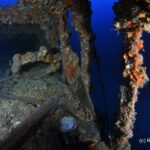
The waters were calm but there were currents all the way down to the wreck. The group made two dives on the wreck, with Richie and Dan finding a number of artifacts inside the vessel; most of which they left for future divers to find. Carrie told Richie that she already felt like she lived in a Bennigan’s Restaurant so he could only bring home china and glass – no brass!
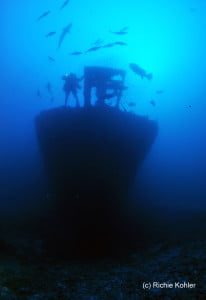
Our next stop the highlight of the trip for our avid group of soon to be transformed treasure divers ( treasure fever seems to hit all of the divers when they watch, as Captain Frank puts it “Pigpen I and Pigpen II digging in the wreck and coming up with portholes, deck prisms, a door lintel, a saucer, and other goodies. True to form treasure fever did hit and the divers elected to remain on the Araby Maid for two days. Not everyone was successful with their treasure collecting, Bernie Chowerdy and his student were forced to abandon the porthole they had been working on and Ian only came back with some incredible video of the wreck (of course that is the only treasure he was looking for).
After leaving the Araby Maid, our cure for treasure fever, we moved on to the wreck of submarine U2513. According to Michael Barnette:
The U-2513 was a Type XXI German U-boat built in 1944. Boasting a length of 252′, she was the most technologically advanced U-boat built during World War II. Advanced sonar capability, greater torpedo delivery (6 bow tubes), greater depth range, and a hydraulic torpedo loader allowed for total reloading in 12 minutes. Known as an “elektroboat,” she could stay submerged for a greater period than her predecessors due to her robust battery supply. Unfortunately for the German war effort, the Type XXI U-boats were introduced too late in the war to make a difference; only 12 Type XXI boats were cruise-ready by the end of the war.
The U-2513 was eventually towed 23 miles northeast of the Dry Tortugas to be sunk as a target by the destroyer U.S.S. Robert A. Owens on 7 October 1951. Supposedly Navy divers visited the wreck in the 1950s, but recreational divers did not visit her remains until almost 1990. She now sits in 214′ of water with damage fore and aft of the conning tower. Part of her sail lays in the sand off to the starboard, with hedgehogs (anti-submarine weapons) residing on the port side.
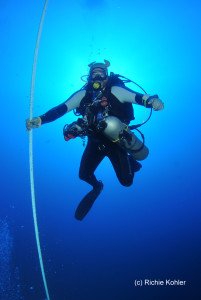
Captain Frank
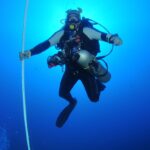
on Deco
According to Captain Frank’s trip report:
… after an 8 hour steam, we arrived at the Vandenberg. Mel got in to set the sideline in zero current. By the time it was set, current was ripping. The Vandenberg has been populated by some pretty cool fish, but the highlight, at least for those on deck, was the ocean sunfish, or Mola Mola that came to visit. It was a small one, about 3 feet fin tip to fin tip. It hung out at the boat for a little while, then wandered off to do fish things.
The next morning Captain Frank put it best, “Saturday morning dawned bright and clear, with a screaming current. No one could swim against it. Melanie used all of her wiles and tricks to put in a sideline, and off we went…. Er… Off we looked and said “Ummm… Maybe another cup of coffee. This was not a “sporty” current but rather a ripping current.
The divers relaxed, lounged, and watched divers on the local day boats try and battle the ever increasing current. At around 11:00 the current had slacked and divers began hitting the water. Like Captain Frank, Dave and I went exploring the wreck to determine its usefulness for future training trips. Captain Frank’s conclusion “…I went to the sand at 157 feet, and sure enough, you can do an advanced nitrox and deco procedures class here.” Dave and I swam the entire wreck, ducking inside from time to time to escape the currents and to improve our view since the visibility was poor due to the currents. I think we decided this will be a good location for future training trips. There are a lot of spots to duck out of the current that do not violate standards for no penetrations as well as a number of good penetration routs for a penetration course.
As with all of my trips with Captain Frank, it was a fun and exciting trip with a lot of good diving. I can’t wait for next year’s wreck trip…I am already signed up.
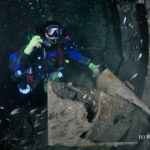
In the Foc’sle