
Fiji – Saweni Bay
Carl Strange Jul 27, 2020
17o28S / 177o24E
At least I hope we have left the west coast of Viti Levu and are snuggly anchored on the tiny island of Waya in the southern portion of the Yasawa group. No cities, no streets, and fewer day charter boats the further north we go
Communications – What we use on Enchante
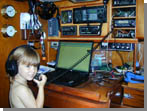
Rebecca Calling Out
Long-distance cruising boats need long-distance radios. VHF works for harbor and anchorage communications but its line of sight and limited to 10-15 miles even with mast-mounted antennas. Up until the mid-80s or so cruising boats had Ham radios because commercial Single Side Band Radios (SSB) were much, much too expensive. You took the Morse code and written exam and talked around the world for free.
SSB radios got cheaper and Morse code never quit being a pain so more and more boats started using SSBs Only commercial, frequency-controlled radios can be legally used on SSB frequencies. Typically these radios are electronically, restricted to the SSB
bands and frequencies. Ham radios cannot legally be used on the SSB frequencies and are electronically restricted to the ham bands. However, Ham radio operators consider themselves radio experimenters and the helpful manufacturers make it trivial to disable the frequency restriction allowing the radio to transmit on any frequency. I would be shocked to find a Ham radio on a cruising boat that hadn’t been altered to work on both Ham and SSB frequencies. When pressed, the ham can point to the regulation allowing any form of communication in an emergency. In reality, the bands are poorly policed, especially internationally. For instance, there is a legal requirement to identify the ship station by radio call sign such as WB5ABC. The great majority of boats simply use their boat name. I would have to dig out my license to look up my Ship’s Station License. In the real world, I am “Enchante“. Ham frequencies are more disciplined and there I am known by my ham call sign.
For voice communications, it hardly matters if you install an SSB or Ham radio with the band restriction disabled. Ham does give you access to a more formal system of “nets” stateside. For instance, the Ham-operated Pacific Seafarers Net meets nightly to track boats traveling in the Pacific. This is a friendly net that runs a formal roll-call of boats underway. If you declare yourself underway you are expected to check in each evening. Should you miss a couple of evenings, the net will get seriously “interested” in finding you. If you are within a day of your destination, they’ll let you slide a couple of days assuming you are sleeping like a log after a long trip or tied up with Customs/Immigration procedures. However, if your last report had you well offshore or you miss more than a couple of days the net will begin to alert authorities and ultimately will initiate a full-fledged search. Hams check into this net knowing it is a lifeline should something go wrong. A more informal SSB net has a much more relaxed attitude about “missing” boats and the daily operator will typically shrug your absence off with something like, “Guess they forgot”. I suppose I prefer the more formal Ham approach when traveling far offshore. On the other hand, most of the useful information about cruising areas, island check-in procedures, problem-solving “why does my starter make this noise?“, and general boat-to-boat chat is carried out on the SSB bands. Hence the popularity of modified Ham rigs.
A huge advance in communications for cruisers started in the mid-90s with the introduction of Email via Ham radio. Although it was painfully slow in the beginning, the ability to send and receive email brought new life to Ham Radio. The software and hardware were developed by Hams for Hams. Being Ham radio the software and shore-based service are completely free. Of course, these guys aren’t dummies and quickly recognized a commercial market was needed to service all those boats with SSB radios since it’s perfectly legal to charge for services on these frequencies. All of a sudden boats can send and receive mail daily instead of waiting for the three-month, bulk mail delivery that contains more junk mail than letters.
Hams get email communications for free all around the world. SSB users pay an annual fee and are allocated something like 15 minutes daily. For a complete description check out K4CJX’s website or search for SailMail. This mode of communication is advancing quickly. Last year I could download weather faxes for fixed areas of the ocean. This year I can download animated, wind, and isobar computer models for a multi-day forecast over any area of the ocean I’m interested in. This is a huge improvement in forecasting weather for a voyage. While anchored in Fiji I can request a five-day forecast extending all the way to the SW corner of Australia. By watching the winter fronts developing over the Tasmanian Seas I can pick a decent departure time and not get clobbered by a cold front during the 1000-mile voyage to New Zealand. At least that’s my plan ;-).
There are many sources of information on radio installations. Being a ham I sometimes like to play around with different antenna designs. Most boats install insulators on their back stays to electrically isolate a long piece of wire. They run an antenna feed line and use this long portion of their backstay as an antenna. I can’t understand doing something silly like breaking up such an important piece of standing rigging with insulators and spending a bunch of money to do so. If one of those expensive insulators breaks you lose your rigging. I ran a separate length of 14-gauge wire from the stern of the boat to the top of my mizzen mast. The ends of this antenna are electrically isolated from the rig with two $1 egg insulators and a couple of short lengths of string. The lower portion of the antenna is tied off at the rear end of the solar panel mount so the antenna doesn’t run right alongside the back stay. This antenna works great and I don’t have to worry about compromising my rigging. My 14-gauge wire (or an insulated backstay antenna’s feed line) leads through a deck fitting and connects to an automatic antenna tuner tucked away in a back locker. Again, lots of information is available on recommended lengths of antennas and installation. Like everyone says it is vitally important, and a royal pain, to install a good ground system. Karen and I spent days running 3″ copper straps. Now we have tied together an external cast-iron keel, fuel tank, engine, solid lifelines and other odds and ends. The more connections we made the better signal reports we received.
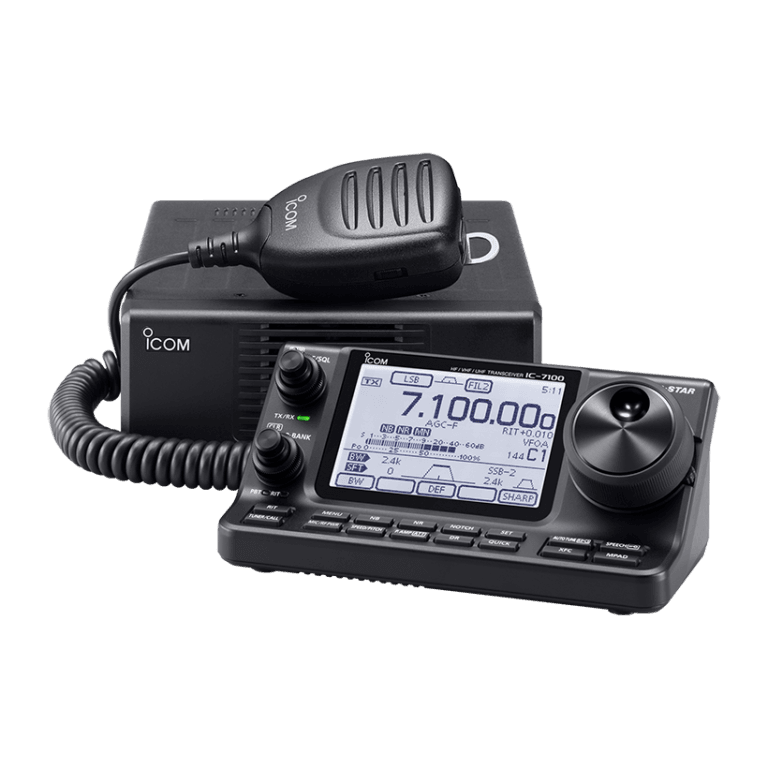
available but a new alternative is
the Icom IC-7100

Carl and his wife Karen set-off on a journey around the world on-board their sailboat S/V Enchante. Along the way, they had a lot of adventures and in Aruba, a new member of their crew was born. Now a family of three with Rebecca’s birth, they sailed the Caribbean and the Pacific experiencing life along the way.