
Hidden Scuba Diving Treasures – Muck Diving
Simon Pridmore Feb 24, 2017
Simon is the best-selling author of Scuba Confidential – An Insider’s Guide to Becoming a Better Diver and Scuba Professional – Insights into Scuba Diver Training & Operations. Both books are available from Oceanic Ventures. Simon has also just published a new book for divers-to-be and absolute beginners called Scuba Fundamental – Start Diving the Right Way.
You roll off the boat and look down to get a hint of the wonders that await you on this dive but it seems you are in the wrong place. There are no glorious coral formations; in fact there is no reef at all. Instead the seabed seems grey and featureless and the visibility is reduced by the presence of a nearby river mouth.
Sixty minutes later, however, you return to the surface with your mind reeling and your camera’s memory card full of pictures of some of the most incredible marine life you could ever have imagined.
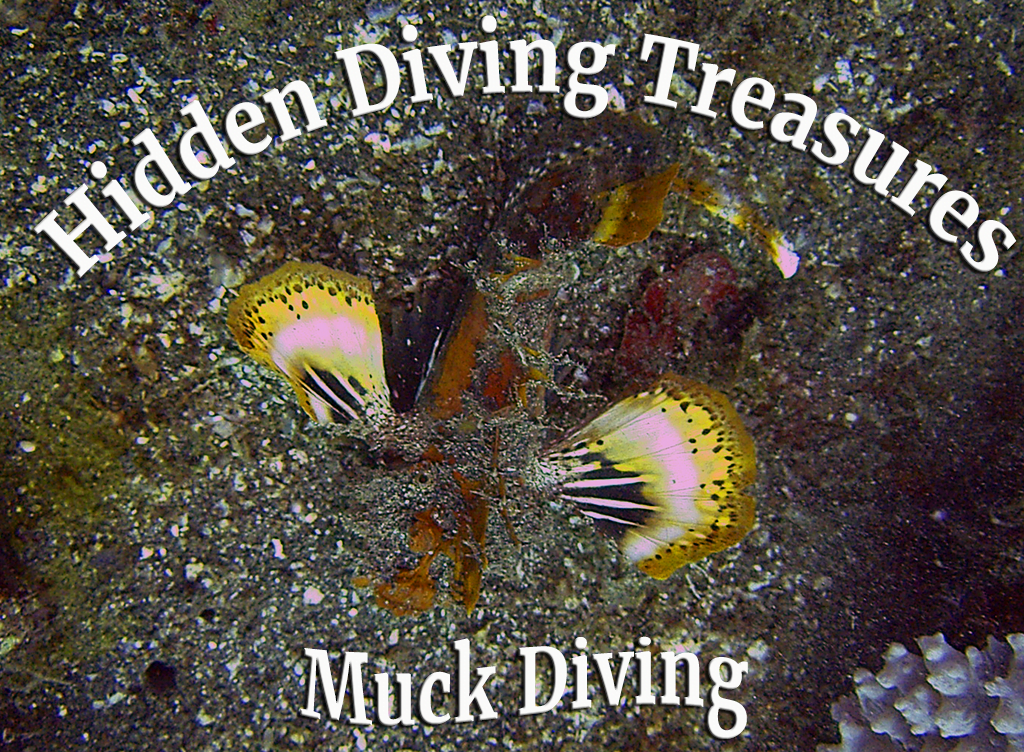
You have just been on an underwater treasure hunt; a game of hide and seek with some very clever opponents. This is muck diving!
The Genesis
While early scuba divers were marveling at the beauty of coral reefs and hanging out in the blue watching for whale sharks and manta rays, a whole universe of amazing creatures were going about their business under the sea completely un-noticed.
How could they have remained undetected for so long? Well, first they were small, second, they had developed the art of concealment to a very high degree and third they lived in places that were not particularly pleasing to the eye. Primarily, however, they remained unseen because nobody was looking for them.
Then a few things happened to bring these little creatures into the limelight.
First, the big fish became fewer in number and harder to find. Second, divers became older and a little lazier and, third, there were significant advances in underwater macro-photography.
Most importantly a few enterprising individuals in Papua New Guinea, Indonesia and Malaysia started looking for marine life in unusual places where nobody had looked before and began to find some absolutely astonishing things.
Muck diving is the quest for these beautiful animals in the sometimes-inhospitable environment where they hide.
Where to Go
New muck diving locations are being discovered all the time but, so far, the world capital is Lembeh Straits on the northeastern tip of Sulawesi in Indonesia. Other locations that also deserve honourable mention include a variety of sites right across northern Bali, Dumaguete in the Philippines, Pulau Mabul off the coast of Malaysian Borneo, Komodo, Ambon and Alor in the Indonesian archipelago and Milne Bay in Papua New Guinea.
Muck Diving Techniques
At first it can appear an impossible task and you will be amazed at how your guides can see things that are almost invisible until you look carefully. Keep trying, however, and with a little experience you will be spotting your own hidden treasures. The thrill of discovery when you find something rare and exotic is hard to beat.
These tips may help: –
- Look ahead as well as beneath you
- Be alert for movement as you pass.
- Follow tracks in the sand
- Get as close as you can
- Examine everything from several angles
- Be patient and take your time
- Move slowly
- Stay as near to the sand as possible without disturbing it
- Use a fin-kick that does not involve downward fin movement so you do not disturb the sand: a gentle frog kick works well
More Spotting Tips
You can also increase your chances of spotting success by knowing where to look, for instance: –
- Ornate ghost pipefish hang out among feather stars.
- Pipefish and seahorses hide among sea grass.
- Baby clown frogfish love rotting wood.
- Sea cucumbers host colourful emperor shrimps as well as swimming crabs
- Harlequin shrimps feed on sea stars
- Urchins are often home to shrimps and baby fish
- Fire urchins are where zebra crabs live
- Tube anemones often have small harlequin swimming crabs on their trunks
- Sea pens shelter porcelain crabs in their fronds

Pointer – OVI Has them in
Essential Equipment
An excellent tool that all the top guides use is a stainless steel 30 cm pointer, which you can thrust into the sand to help you balance as you hunt for animals. You can also use it gently to move aside a concealing weed to see more clearly. Attach the pointer with a lanyard to your BCD and tuck it into your harness when you are not using it.
Just Scratching the Surface
Remember, many of the creatures being discovered by muck divers today are new to science. It is exciting to imagine how much more there is to learn and what surprises remain to be discovered by someone with patience, a sharp eye and a pointer.