
Hiva Oa in The Marquesas (#8)
Carl Strange Oct 17, 2019
23 June Taahuku Bay, Hiva Oa, Marquesas 9 48 S / 139 02 W
on the currency exchanges – dollars converted to PolyFrancs to pay the bond – refunded in PolyFrancs then converted to dollars. We smile and pay the bond.
Friends have reported the town is wonderful complete with groceries and fresh food — if you come on the right day. It’s been a long time since we visited a place with regular air and sea freight service and the differences are staggering. The stores have much more than simple basic supplies. Of course, the prices are outrageous compared to Central and South America. Knowing this in advance, Enchante’s lockers are packed with almost a year’s worth of food. Karen has done a great job and we need little – mainly pasta, fruit and vegetables. Since these are staples with locals everywhere they are always reasonable. Of course, we splurge on ice cream, even buying some for a couple of other cruising kids Rebecca is friends with. At $7 for three cones, it’s made clear what a “rare” treat ice cream is going to be.
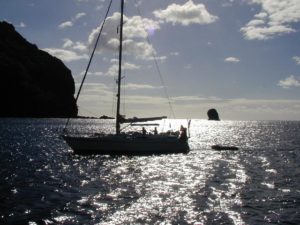
The anchorage is small and rolly so everyone puts out a stern anchor to hold their position in the shifting currents. Of course, this means a snarl of lines and twice as many anchors to drag in a blow. Since we’re held in one position despite the direction of the winds, we lose much of our natural ventilation. This may turn out to be a hot and buggy place. It’s a mile walk over a hill to get into town. The delightful locals are good at spotting cruisers walking on the road and frequently stop to give rides.
Rebecca and I were sitting on a bench in front of one of the little stores while we waited for Karen. We were chatting and enjoying people-watching when a nicely dressed man walked up and said, “Boy it’s great to hear English. Can I talk to you?” He was a young Mormon missionary in his second year of a two-year service in the area.
Fresh out of Utah, he spent a few weeks in Tahiti learning French and Marquesan and came to join a small program in Hiva Oh. Here he lives with a local family and is completely immersed in the language and culture. According to him, the locals are losing their native language to French and English. He can have long conversations with older people but the children spend hours watching satellite TV and can only exchange a few words. There are several churches on these tiny islands and he said we would see many on every one we visited. He is enjoying his service but is getting excited about returning home. We had a nice time chatting and learned a couple of new Marquesan words.
30 June
Okay, okay, okay! I just checked the running “From the Log of…” and it has been a while since our last update. Just for your information, we arrived safely in Fatu Hiva and stayed for a few days. The morning winds, that blasted down the mountains, drove us away quicker than we would have liked. Since then we’ve checked in at Atuana, Hiva Oa, and spent a few nights anchored at isolated spots on Hiva Oa and Tahuata. We’re traveling in loose company with a British couple on S/V Hannakin.
The general plan is to be drift diving in the pass of Tuamotu island in a few days.
The locals have been very friendly in the small, outlying villages. The one larger town we visited wasn’t so gracious. Everyone has fruit growing in their front yards and we’ve had no trouble trading for limes, bananas, coconuts, and Pamplemousse. French baguettes are available, hot and fresh, at $.40 per loaf. Sadly, tomatoes, potatoes, cucumbers, onions, and other vegetables are harder to come by. The locals have a few farms up in the valleys but we haven’t stayed in one place long enough to work out a trade.
The man on S/V Hannakin was PADI certified in ’92 and hasn’t been diving since. He asked for a class so we’ll work our way through a quick refresher course and head for blue water.
I have managed my first dive in the South Pacific. A short visit to a pretty reef at 40 feet then an hour of scrubbing the bottom. Our brand new Jotun paint isn’t working well at all. Our paint in black. S/V Hannakin has been in the same conditions with Red Jotun and looks great. Our theory is so much pigment is added to make the paint black that the copper/tin additives end up very diluted.
We’re still moving frequently to get to the isolation of the Tuamotus in fairly short order. Still, I’ll make time to sit down and write another installment of “From the Log…”.