
How Things Work – The Scuba Air Delivery System
Ann Keibler Apr 19, 2011
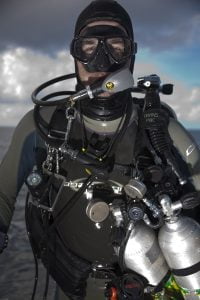
Earlier, I wrote about the need to properly maintain your BCD. It is a crucial part of our portable life support system that we carry with us when we enter the strange and magical underwater world. While each element of our dive system is important to having a safe and enjoyable dive, there is no component more important that our air delivery system- it is at the pinnacle of our portable life support system hierarchy. It delivers breathing gas to us in an environment that would otherwise be hostile, and yet despite its importance, like most other parts of our dive system it goes about its business unheralded, without complaint and typically, almost entirely unnoticed.
Think about that for a moment- except for brief moments when the mouthpiece is uncomfortable or we have a free-flow that startles us, the air delivery system fades into the background, and we instead focus on the fins that are too tight or the mask that hurts our nose. The truth seems to be that the air delivery system simply, well…works. It delivers breathing gas to us when we want it, seemingly no matter what else is going on during our dive. I think that’s a really good thing- a piece of equipment so critical to our survival, often ignored, and yet it keeps on doing its job dive after dive It should
go without saying that since the air delivery system is a piece of life support equipment, it’s not a place to scrimp. Further, it is one of the parts of a dive system that you really should own.
Years ago, back when we still had coal-burning wristwatches and communications devices called “letters” were actually written using your hands, the air delivery system was, to be kind, primitive and less, can we say, reliable. My aim here is not to discuss the evolution of the technology, but rather to explain how these things work, in practical terms. My discussion will be limited to the typical, open circuit demand systems, which we usually refer to as our “regulator.” Also, while you can find extremely detailed explanations, including the physics, concerning the operation of air delivery systems, I’ll restrict this piece to a functional overview.
In reality, the air delivery system does regulate, so that’s not truly a misnomer. However, despite the device’s purpose of regulating the pressure and flow rate of breathing gas, that term doesn’t really do it justice- the regulators (a primary and a secondary) are pieces of a more sophisticated system. That system prneudes us with a main and an alternate source of breathing gas, connects to our information systems so we know some critical things like cylinder pressure, and allows us to effortlessly inflate our BCD.
OK, I lied a little about the physics part, but it’s important to know WHY you need an air delivery system. The human respiratory system is unable to tolerate large differences in pressure, and at depth the ambient (atmospheric plus hydrostatic) pressure is sufficiently high that our lungs cannot expand against that pressure. For this reason, we cannot breathe through a long tube from the surface, and instead must breathe gas that is delivered to our lungs at a pressure very close to ambient- which increases as we go deeper. A scuba regulator, part of the air delivery system, delivers breathing gas to us at pressures very near to ambient (actually a little less than ambient) when we inhale or when we “demand” the gas, and not at other times. Hence, the term demand air delivery system.
That we have a demand system should help clarify why it sometimes feels like we have to pull gas into our lungs when we breathe, and that can occasionally be a little disconcerting. If the breathing gas were delivered at true ambient pressure, our second stage would flow freely, unrestricted, which could quickly deplete our gas supply. So, the “regulator” delivers breathing gas to us at slightly less than ambient pressure and only when we demand that gas.
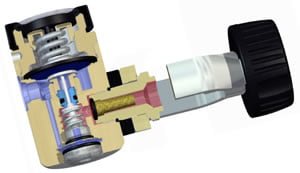
Zeagle First Stage Flow Digram
not have to work harder to breathe as depth increases.
If you think about how we calculate ambient pressure based on depth, one thing becomes apparent. There is a depth at which ambient pressure will exceed the intermediate pressure, and the second stage will be unable to deliver any breathing gas. Fortunately, that depth is in excess of 270FSW, well past the 165FSW outer limit of recreational diving.
Again, I want to stress the system aspect here. The regulators are two parts of a total system which includes the hoses connecting the first and second stages, the low pressure hose for inflating our BCD, and the hose (or port) that allows us to connect our cylinder pressure gauge or computer sensor. All elements of the “system” need to work properly, together.
Now that we have an understanding of the physics, it’s time to talk briefly about the types of regulators that go into our air delivery systems. Starting with the first stage, there are two mechanical variants: piston and diaphragm, each of which reacts based on external water pressure. As the names suggest, the piston type has a piston with a rod that opens and closes the main valve on the first stage, while a diaphragm type has a diaphragm that connects to the main valve through a push rod. In either case, when breathing demand causes a pressure drop across the first stage, the main valve opens, keeping the intermediate pressure at the desired value.
From the user standpoint, there is little difference between a piston and diaphragm type first stage, as long as the regulator is good quality and in good repair. From the technical perspective, there are advantages to either design, none of which outweigh the disadvantages of the other! The main criteria is the regulator’s ability to deliver air when needed, and this can be based on your breathing pattern, type of diving, the potential need to support two divers working hard, water temperature, and other factors.
Possibly more important than the mechanical variant -piston or diaphragm- is the matter of the first stage being balanced or unbalanced. Almost without exception, good quality, high performance first stages are of the balanced design, and there’s solid logic underlying that. A balanced design will deliver gas across the first stage at a consistent rate and do so without regard to the pressure in the cylinder. An unbalanced design makes use of cylinder pressure to help “trip” the main valve, so when the cylinder is full, the valve trips easily with little effort, but as the cylinder pressure declines, the effort required to trip the valve can increase considerably. A balanced design will prneude consistent performance at any depth and cylinder pressure, making your breathing efforts likewise consistent, and as a result, your dive more comfortable. If you want a detailed explanation, come by the shop and we’ll talk you through it.
Second stages have been manufactured in a variety of mechanical configurations, just as first stages have been. However, for the purposes of this discussion all use the diaphragm system with a “downstream” valve, and are in fact balanced. The advantages of the balanced design are consistent breathing effort and high gas flow when and if needed, no matter the depth.
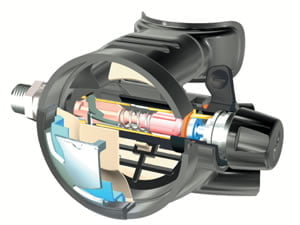
Zeagle Second Stage Flow Cut-Away
There are other variations in second stage regulator designs, some of which can serve to make the regulator more reliable, certain diving situations easier and make servicing the regulator simpler. While the first stage regulator is a comparatively complicated piece of equipment that should be serviced ONLY by trained technicians, with some instruction the second stage can be field serviced. An Equipment Techniques specialty course will give you insight into what field service you can safely undertake.
So, to end where we began, our air delivery systems work, and I hope that you now have some idea of the difference in designs and how they work. No matter what design you have or you choose, there are a few key things to keep in mind:
- An air delivery system is a piece of life support equipment and you safety should be the primary factor in your selection.
- In life support, price does mean quality, so get the best you can afford, no matter your skill level or experience.
- Your air delivery system delivers critical breathing gas, so choose a system that offers high performance and can be readily serviced.
- Seek guidance in making your decisions by buying from an experienced, accredited dealer.
At OVI we’re here to help you choose your air delivery system, configure it properly based on your style and preferences, to prneude service and maintenance, and to help you be a safe and comfortable diver.