
Lights – They’re Not Just for The Scuba Diving at Night
Ann Keibler Jan 25, 2011
OK, so I struggled with a cute title for this blog, but I hope that the intent is clear: to shed some light (I can’t help it) on why you should carry a dive light -or even two- with you whenever you’re in the water. That’s right, even during the day, a dive light is a good idea.
During night dives, we carry lights (plural) for obvious reasons: it’s dark in the water and we need the light so we can see things that make night dives interesting; plus, we use the lights to allow us to see our buddies and the rest of the dive group in the water. We typically carry two lights during a night dive, a primary and a back-up in case the primary light was to fail.
During a day light dive there’s no real issue with locating your buddy or the rest of the dive group if the visibility is half-way reasonable, so why would you want to carry a dive light during the day? On a lovely sunny day in the Caribbean or the South Pacific there’s plenty of light to see the reef and structures, the fish and other critters, your instruments, your buddy’s hand signals, and enjoy the experience. Even with cloud cover you can still see all of this, right?

Flat Light Casts a Blue Cast to the Reef
Sea Fan with White Light Added Back
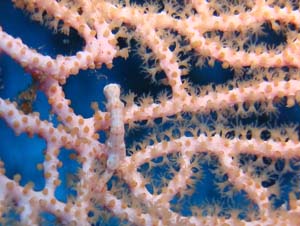
Pygmy Seahorse
But Just a minute, did we see everything that we could? During the dive briefing the dive leader told us that we would find a bright pink anemone on a coral mound. During the dive did we notice the great colors in that anemone, on that nudibranch? Do we even know that this species of coral is actually a bright red color or that the fan coral had a pygmy sea horse on it? Did we even notice things of interest prior to the dive leader pointing them out to us? When we look at a guide to the local marine life we see brightly colored fish and corals- why could it be that they seem “different” to us during our dive?
For me, even after 27 years of diving, I still get a thrill out of seeing that same fish for the 1000th time, or finding a spotted moray, a lobster or a cleaning station, and I like to find things on my own sometimes. After all, diving is a certain amount of exploration and shouldn’t be merely swimming in a line following the dive leader until we’ve used up our gas supply. I dive to see things, whether that’s marine life, features of a reef or a wreck, and just like on land we see things underwater as light that’s reflected from the object and into our eyes. Therefore, I need light in order to see things. OK, so, where am I going with this?
Well, let me illuminate my thoughts. Harken back to your Open Water Diver training and recall that water is considerably more dense than air, and that density results in some effects on us in an underwater environment- not the least of which is an increase in pressure based on depth (No, this is not an essay on Boyle’s Law, but don’t forget the First Rule of Scuba).
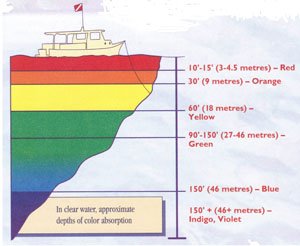
Light Absorption from the Scuba Schools International Open Water Manual
That is to say that we take our “terrestrial environment” with us when we submerge, as being air breathing, we are unable to breathe underwater without a supply of air; and being accustomed to seeing in the less dense atmosphere that is air, we carry our environment in the small air space inside our mask. So, if we want to see things as they really are, why not carry another piece of our terrestrial environment with us? By that, I mean an underwater or dive light.
First, an underwater light is basically “white” which is to say that it is all parts of the spectrum. When we shine that “white” light on an object, the light is reflected back to our eyes allowing us to see it. Now, the same physics apply here, in that the reflected light can be absorbed by the water but if the light is close to the object, and we are in turn close, the light travels a relatively small distance and thus little of it is absorbed. So, what reaches our eyes is practically the full spectrum. This means that what we “see” is the true color of the object, and automagically, when we shine a light on that anemone we actually see that it is a brilliant green color, with the tips being like neun lights. WOW! Likewise, that Blue chromis has an amazing “dapple” of colors.
Now, during that dive, we swam around the reef and noted that there were all kinds of nooks and crannies in the coral, sponges, rocks, shapes and sort-of-colors. If we had a “white” light with us, not only would we have seen the anemone, but we also could have directed that light into a crevice and seen the red and white banded coral shrimp that were at the cleaning station where the spotted moray eel was sitting there with its mouth wide open, being cleaned! Without the light, we would not have been able to see into the reaches of the crevice.
Now, to throw a little more physics on the wall, a “white” light seems simple enough, but many lights do not produce a “white” light, instead producing a light that has a yellow cast to it. An incandescent light (i.e. a bulb light) is likely to produce this yellowish light, while an LED light will produce a truer, whiter light. The whiter the light, the truer the colors will be in the underwater environment.
Last but not least, a light source prneudes contrast not only in colour but also in texture. It can also prneude a more evident depth of field, making distances more obvious. The advantage in contrast can allow you as a diver to see differences in texture, produce shadows, and as a result, find and see some very interesting things, like that pygmy seahorse! You’ll probably now remember that the dive leader carried a light on our dive, and used it to direct our attention to whatever he or she wanted us to see.
So, to wrap this all up, if like me, you dive to see things, then in order to see things, a light is truly indispensible during any dive. An underwater light restores color, prneudes contrast and even in the day, allows us as divers to look into and under those cracks, ledges, holes and see the things that, after all, we got into the water to see.
Come and see us at the store, and we can get you set up with right underwater light for your next dive trip!