
Preplanning a Scuba Diving Silhouette Photograph
Eric Keibler Feb 14, 2011
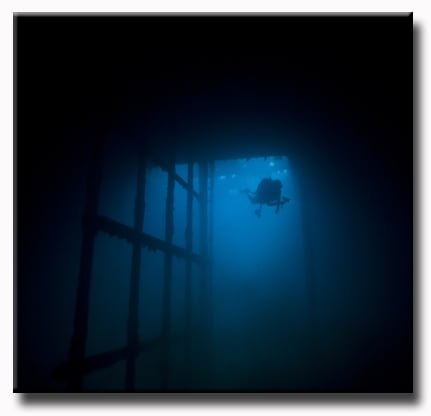
Penetration
© Eric V. Keibler
Here is a natural light photograph taken in a cargo hold in Truk Lagoon. While the shot may look completely natural, it was set-up prior to getting in the water. Todd Emons and I decided to go in the water together to take some photographs of one another in various locations on the ship.
Todd works on the Odyssey so he is very familiar with the wrecks and had some ideas of what shots might look good in this wreck. This type of local knowledge helps you to capture photographs that you might otherwise miss. Of course, you still have to do everything to take the image but setting up the shot can make things easier. You need to discuss the general sight and then make a plan with your dive buddy. It is easier to discuss what you want to do on the surface rather than underwater. Working with a model can be quite challenging underwater and having a plan before you go in makes it much simplier.
To take this shot, I swam to the lower portion of the cargo hold. While getting in position, it was important not to kick up the bottom or dislodge too much debris from the ceiling because the debris would ruin the shot. I set the camera on manual and set the camera to properly capture the blue light throwing everything else into shadows. After everything was set, I signaled Todd who was perched at the lip of the hold and he began to swim toward the camera being careful not to shine his light in the direction of the camera. You can see just a small beam coming from the light but because the hold was so large, and the backlight so strong, his light had little effect in the final image.
Also notice that while Todd is the subject of the shot, he is not in the center of the image but rather is in the top third of the picture. In general, it is more pleasing to the eye if the subject is not centered but rather offset into another quadrant. We call this division the rule of thirds which is a compositional tool. Look for a better discussion of this “Rule” in another post on composition.
Remember, when taking silhouette shots, it is important to make sure that you keep the meter reading set for the backlight and not let the camera adjust to the target swimming towards you.
Camera Specifications: Canon 5D, fitted with a 17mm-40mm lens at 20mm, f4.0 at 1/25 sec, ISO 640