
Scuba Diving – Get Control of your BCD!
Simon Pridmore Feb 09, 2016
A note about the author – Simon is the best-selling author of Scuba Confidential – An Insider’s Guide to Becoming a Better Diver and Scuba Professional – Insights into Scuba Diver Training & Operations. Both books are available now from Oceanic Ventures.
As you discovered when you first learned to scuba dive, the letters BCD stand for Buoyancy Control Device. This implies that your BCD is an appliance that controls your buoyancy in the water. It would be nice if that were the case but sadly it is not true. No matter how technologically advanced your BCD is, you are still the one responsible for controlling your buoyancy in the water. Your BCD is just a tool that you can use to help you.
But first you need to get the BCD itself under control!
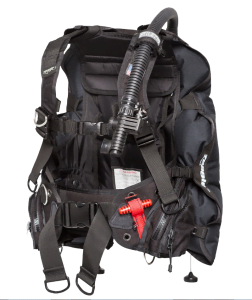
Buy the right one
Most people buy BCDs that are the wrong size because they try them on in a dive shop while standing up and wearing their normal land-based-life clothes.
Try the BCD on in the shop while wearing your wetsuit and once you have chosen a model, ask to try a sample out in the pool first. Take along the size that fitted you best in the shop and take the next size down with you also. The smaller one is probably the one you will keep.
Your BCD should fit you closely, especially around the shoulders, but not restrict normal movement nor constrict you with the bag full and the straps loosened. It must have enough buoyancy when fully inflated to float you comfortably at the surface with your head clear of the water, but no more.
It is best avoid the bulky, top of the range models. They are usually very buoyant even when not inflated and will require you to wear a lot of extra weight to compensate. An oversized BCD can start moving around on its own under water and be impossible to control!
Know how it works
Spend plenty of time studying your new BCD. Hold it up in front of you horizontally and imagine where the air will be when you are underwater. It will always be in whichever part of your BCD is closest to the surface.
Learn where the controls are. While you are swimming, practice finding your inflator mechanism by touch alone: then, practice using it in different positions. Remember it is not a pump; it will only release air when a) it is above your left shoulder and when b) your left shoulder is the part of your body closest to the water’s surface. Otherwise the air will remain trapped inside no matter how fiercely you depress the button. See how need to turn your body while swimming so that your left shoulder is at the highest point. Usually you can manage this by dipping your right shoulder.

Notice that if you are swimming with your head down and feet up, the air will be close to your butt. Most BCDs have a “tail dump” so you can release air in this position. Make sure you know instinctively if the tail dump is on the right or left. Learn how to empty your BCD completely. Failure to master this skill can make it difficult for you to descend, cause you to carry too much weight to compensate and, worst of all, place you at risk of an out of control ascent.

Set it up properly
Control your safe second stage (octopus) and your console so that you know where to find them instinctively when you need them and also so that they do not swing around below you and damage that beautiful coral you are swimming over. This means controlling the object at the end of the hose, not just the hose. Clips that retain only the hose still allow the object on the end to swing free below you and turn your accessories into reef-wrecking balls.
Minimize the number of extra bits and pieces you carry on every dive and make sure the essential items things, such as your safety sausage and dive light, are stowed away or attached securely. The two golden rules are:
- only one thing in each pocket because if you have several items in the same pocket and pull one thing out, everything else will come out with it: and
- attach everything by two points so that,
- it does not dangle and,
- if one of the attaching points breaks you do not lose it.