
Underwater Scientists Discover Camouflage Techniques
Ann Keibler Jun 27, 2013
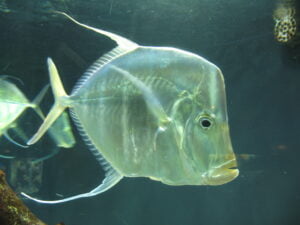
Photo by: Milla-Maria Salo
Scientists at the University of Texas at Austin recently found that some open water fish such as the Lookdown have a way of camouflaging themselves by reflecting polarized light at different angles. Polarization of light occurs when light waves are aligned parallel to one another. Humans are not able to see polarized light well; however, many types of fish can. Most fish use their scales as mirrors to reflect the color and intensity of the light hitting them, which then gets distributed evenly into the water surrounding the fish. This serves to camouflage the fish, and has been thought to be the major way that fish avoid detection. However, some fish have evolved to reflect polarized light such that it matches the majority of light polarization found in the water at a specific time. As the sun moves throughout the sky, the polarized light field is constantly changing, which could make fish vulnerable to predators that can detect polarized light. Lookdown fish use their scales to change angle of the polarized light hitting them, to match the
angle of light found most in the water at that time. Scientists are not sure how the lookdowns do this; however, they think that understanding the process could be useful in future technology such as camouflage for boats that travel in open water.