Underway, Journey toward the Marquesas (#5)
Carl Strange Sep 26, 2019
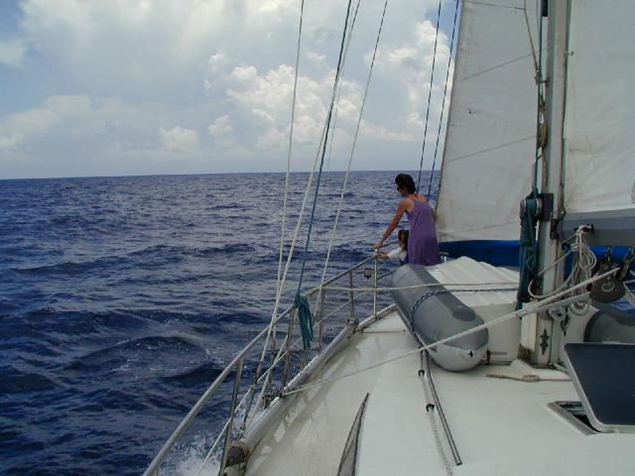
6 June 2002 Our position is 06 22S / 111 51W.
We’re more or less half-way there and all is well onboard. Stories to follow if I can pry Rebecca’s computer away from here during daylight hours. Don’t know if I reported mine has a keyboard problem and is useless right now.
10 June 2002 – 07 46S / 123 41W
The Galapagos are 2100 miles and thirteen days behind us. The Marquesas are 900 nautical miles and about one week ahead. We’ve seen nothing on the horizon but blue water and white clouds for days and days. Except for the occasional night squalls, our weather has been picture perfect for the trip.
We have had great luck fishing and are enjoying Mahi Mahi (or Dolphin or Dorado) again this evening. Today’s catch was just over three feet and will keep us in fish for a couple of days. Most of the fish will be baked but a few nice pieces have been put aside to have as a sashimi (okay, thinly sliced, cold, raw fish) appetizer. Our lockers always have a good supply of Wasabi, the hot mustard that goes with sushi or sashimi.
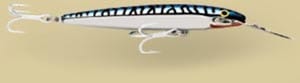

Mahi
Mahi
Mahi Mahi is the most widely known of Hawaiian fishes, Mahi Mahi is the Hawaiian name for the Dolphin Fish. A prized sport fish, Mahi Mahi has firm, white flesh similar in appearance and texture to halibut, but with more flavor. Mahi Mahi holds up well on the grill, and is also a great choice for baking or sautéing. Its mild flavor lends itself to a variety of saucesFrom buygreatseafood.com
Our meat line deserves a description. This is sixty feet or so of 1/4″ three strand nylon line. A large stainless swivel is tied to the “fishing end”. Ten feet or so of 120 pound stainless wire follows that with a second swivel and snap hook crimped on the end. The leader of a lure is attached to the snap hook and the line is trolled behind the boat. Since the 1/4 line won’t give when a fish strikes we use a four foot piece of heavy bungee as a shock absorber. One end of the bungee is tied to a loop in the 1/4 line and the other end is tied to the aft rail of our boat. Finally, the 1/4 line, with a good bit of slack, is attached to a large cleat on our aft deck. Now when a fish strikes, the bungee will stretch giving the fish a bit of play. Should the bungee break, the 1/4 will take the load. Much like Tom Sawyer tying a fishing line around his toe, we use a clothes pin to hang the slack loop of 1/4 line up in the rigging so we can keep an eye on it from the cockpit. When a fish strikes, the bungee stretches, the loop pulls out of the clothes pin and we eventually notice. It’s a crude but very effective way to fish.
16 June 2002
We spotted Fatu Hiva at 1800 Z or 9:30 AM local. Actually, it was Revision II who called us on the VHF and pointed it out. It’s about 1:30 and we have at least an hour or 2 to go before we are anchored. I hate that it takes so long after you’ve started celebrating to actually get anchored. All in all, it has taken 19 days. Not bad. An average of 161 miles a day. The island is gorgeous. Definitely a sight for sore eyes. Can’t wait to go on shore tomorrow and explore. The supposedly have a lovely waterfall, though it is quite a walk to get to it. We’ll only stay a few days and then go to Hiva Oa to officially check in.
Paradise at last! YEA!