Dave Talks About Rebreathers – Part 2, CO2
David Snyder Jan 07, 2011
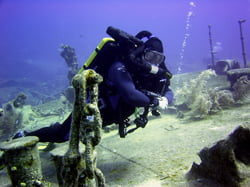
Eric on an Inspiration Classic
in Grand Cayman
As for a CO2 hit, the symptoms are headaches, rapid breathing then unconsciousness. When in doubt bailout.
Q: On open circuit, I breath very lightly, but it would seem to me that, that style of breathing would not lend itself to rebreather?
All rebreathers have unidirectional gas flow. This is done via flapper valves on either side of the bailout valve (BOV). Breathing type or rate is irrelevant to the movement of gas within the loop. There are some issues related to dwell time in the scubber media in extremely rapid breathing conditions. This would be a CO2 issue.
Q: Is it the outside pressure exerted on the counter lungs that forces your breath through the scrubber, and thus returning it to you?
As your lungs expand the counterlung collapses, as you exhale the counter lung expands, pressure on one cancels out the other. External pressure is not relevant, but gas density is however. Counterlungs are but one part of the loop. Work of breathing (WOB) is the resistance encountered. Commercial rebreather units have to have acceptable WOB else no one would buy them. Some units are better than others.